It’s been a very long time. Visiting Biotop Lechnica the other day, I suddenly realized that four years have passed since the days when I spent nearly every moment in front of my screen. It felt like one endless stretch of autumnal-early winter greyness, dragging on without much hope. What provided temporary relief from the various disasters and catastrophes of the COVID-19 pandemic were the exchanges that inevitably took place on Zoom. This was in contrast to MS Teams, the platform officially adopted by my university for online teaching, which even now feels far more corporate to me.
As I looked at the familiar surroundings and the particular hue of grey light outside the window, I was surprised to notice that the experience still lingers. It remains deeply embodied, visceral, and troubling. To a great extent, I’ve managed to push it to the very bottom of my everyday life, except on late autumn foggy days spent in Biotop Lechnica. This place, which saved me at the time, seems to carry some of the pandemic’s residual trauma even now.
Yet, much to my surprise, I somehow managed to transform some of those then-traumatic personal experiences into two publications, both of which have seen the light of day this year. These are chapters in edited volumes.
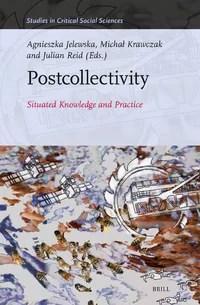
In the chapter “Not-Only-Human-Habitat, or Pedagogies of Vulnerable Collectives in the Age of Extractivist Fantasies” (published in Postcollectivity: Situated Knowledge and Practices, edited by the brilliant duo Agnieszka Jelewska and Michał Krawczak of the of Humanities/Art/Technology Research Center in Poznań), I shared some of my experiences with pandemic-era online teaching. This chapter focuses particularly on the sense of failure that accompanied one of my classes during the first year of the COVID-19 pandemic.
As I wrote for Kudos:
Looking into permaculture design and the practice of sustainable gardening, I develop the ideas for digital pedagogy that would both account for environmental impact of digital technologies and foster community building in the classroom. The method does not shy away from problems and difficulties, but – to the contrary – sees such moments as potential openings for the emergence of new knowledge or a chance to strengthen the motivation. The article praises the art of failure as a pedagogic method and a tool of critical thinking.
Never heard about Kudos? Neither have I, until the moment the book was finally published and I started getting all those reminders to “grow the influence of my research”. Finally, it turned out that to receive a printed copy of the book containing my own chapter, I had to write a short “story” about my research. So, I did—without believing for even a second that it would contribute to anything other than benefiting yet another company profiting from our unpaid labor.
Why I chose to do so, despite my reservations, is something I will reveal in one of my upcoming blog posts. I’m increasingly intrigued by the extent to which neoliberal, heavily platformized academia has diverged from the real lives of academics.
BTW, if you’re interested in reading about my failures and how permaculture gardening inspired my digital pedagogy, just let me know in the comment below, or at any channel you can PM me. The volume is not in OA.
Another publication though, is. A chapter signed by all research team members (myself, Søren Bro Pold and Scott Rettberg) and stemming from an almost year long COVID-19-related research project funded by Theme Funding of DARIAH-eu Small Grants has just been published in Encountering the Plague. Humanities Takes on the Pandemic, edited by Wojciech Sowa and Tony Whyton. The chapter is entitled “A Pandemic Crisis Seen from the Screen: A Reflection on Pandemic Imagination” and is based on a set on interviews with artists contributing to the Covid E-lit online exhibition that we curated in 2021 for the Electronic Literature Organization Conference and Festival. The interviews were to some extent included in a full feature documentary that was also one of the outcomes of the project. That work kept us glued to the screens for long hours in 2021, often late into the night because of working across many time zones. Discussing digital artists’ responses to the pandemic limitations and constraints, we couldn’t help let the then everyday creeping into these discussions: who had the access to the first vaccines and who had not, were these mRNA or not, where did they come from, what anti-mask and anti-vcxx movements were up to at that time in our respective countries (maybe except Scandinavia, where no such movements were visible), who was under a full lockdown (again). Not much of this, of course, made into a chapter, but a movie preserves a (less-than-comfortable) vibe of the day.
Three years have passed since then. The neofascism is gaining power (again). AI and Silicon Valley imperialism are getting ever closer. The former and the latter are not unrelated.
The crevice between platformized academia and the real life of academics has becoming ever more palpable, which is a topic I’ll explore to a greater detail in my next blog post.
 breathing in academe
2 responses to “Between neoliberal platformized academia and real life of academics”
Great post! I clearly follow you. Though I’ll add that our project and the results from it also means that I don’t only look back with sadness and trauma but also with the feeling that we (and here I also include the artists that took part in the interviews and were part of the exhibition) got something valuable out of it. At least a moment of reflection.
LikeLike
Yes! Absolutely! A very good point and thank you for this comment. You’re right, the project was also a great boost of energy in difficult time – I should have mentioned that. It is just that this difficult part is an embodied feeling for me and I got really surprised to see how much it lingered. But definitely without all the great conversations we had at the time, the pandemic would have been much more traumatic.
LikeLike